
Fire Extinguishers
Wet Chemical (K-Class) — ISI Marked & BIS Certified
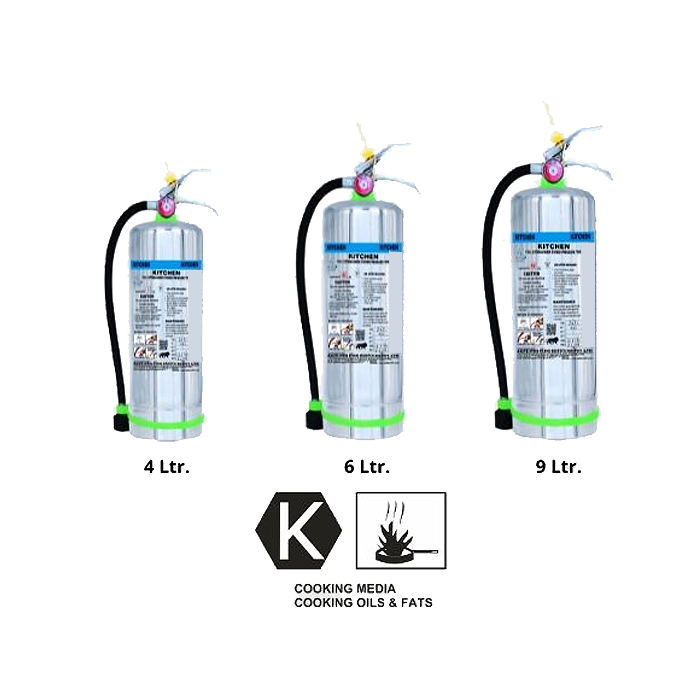
Kitchen Fire Extinguishers
HMJ kitchen fire extinguishers offer distinctive unique features by reacting chemically with cooking oil fats (saponification) & forming a non-combustible layer on the surface, thereby providing a very fast flame knockdown and complete securement of grease-related fires. The high reactivity of chemicals reduces fire intensity of oil immediately, and it does not produce any hazardous by-products due to fire or reaction with burning oil. Our extinguishers offer ease of post-fire clean-up and are totally non-corrosive products.
What Makes Kitchen Fire Extinguishers Special?
Kitchen fires are classified as Class K fires (cooking oil and fat fires) and require special extinguishing agents. Regular fire extinguishers like water, CO₂, or ABC dry powder are ineffective and can even be dangerous when used on cooking oil fires.
How Kitchen Fire Extinguishers Work
Kitchen fire extinguishers use wet chemical agents that work through a chemical process called saponification. When the wet chemical agent makes contact with hot cooking oil or fat, it creates a chemical reaction that converts the burning oils into soap compounds (potassium salts).
Cools
The agent rapidly reduces the temperature of the burning oil
Smothers
Forms a blanket-like foam layer that prevents oxygen from reaching the fuel
Seals
Creates a barrier that prevents vapors from reigniting
Converts
Transforms the burning oil into a soap-like substance through saponification
Product Features
Available in various capacities and variants: Stainless Steel Cylinders and Standard Mild Steel Cylinders.
Technical Specifications
| Specification | HMJ 2K | HMJ 4K | HMJ 6K | HMJ 9K |
|---|---|---|---|---|
| Cylinder Material | MS / S.S | MS / S.S | MS / S.S | MS / S.S |
| Capacity | 2 Ltrs | 4 Ltrs | 6 Ltrs | 9 Ltrs |
| Extinguishing Medium | Wet Chemical | Wet Chemical | Wet Chemical | Wet Chemical |
| Discharge Time | > 8 sec | > 13 sec | > 13 sec | > 13 sec |
| Discharge Range | > 2 m | > 2 m | > 2 m | > 2 m |
| Operating Pressure | 15 Bar | 15 Bar | 15 Bar | 15 Bar |
| Test Pressure | 35 Bar | 35 Bar | 35 Bar | 35 Bar |
| Expellant | Nitrogen | Nitrogen | Nitrogen | Nitrogen |
| Empty Weight (Approx) | 3.5 kg | 5.4 kg | 7.2 kg | 10.3 kg |
| Full Weight (Approx) | 5.5 kg | 9.4 kg | 13.2 kg | 19.3 kg |
| Height (Approx) | 380 mm | 460 mm | 540 mm | 570 mm |
| Diameter (Approx) | 110 mm | 140 mm | 160 mm | 180 mm |
| Certification | ISI Marked | ISI Marked | ISI Marked | ISI Marked |
| Warranty | 1 Year | 1 Year | 1 Year | 1 Year |
Comparison with Other Fire Extinguisher Types
| Feature | Wet Chemical (K Class) | ABC Dry Powder | CO₂ | Water |
|---|---|---|---|---|
| Effective on cooking oil fires | Excellent | Poor | Poor | Dangerous |
| Prevents re-ignition | Yes | No | No | No |
| Safe for kitchen use | Yes | Moderate | Yes | No |
| Cleanup after use | Moderate | Difficult | Easy | Moderate |
| Creates cooling effect | Yes | No | No | Yes |
| Forms sealing layer | Yes | No | No | No |
Ideal Applications
Maintenance and Care
Proper maintenance of kitchen fire extinguishers is essential to ensure they work effectively during emergencies.
Monthly Inspection
Check pressure gauge is in the green zone, ensure there's no physical damage, verify the pin and tamper seal are intact, and confirm the unit is properly mounted.
Annual Maintenance
Have a certified technician conduct a thorough inspection, check the internal components, and verify the wet chemical agent's condition.
Five-Year Service
Every five years, the extinguisher should undergo hydrostatic pressure testing to ensure the cylinder integrity.
Recharging
Recharge immediately after use, even if only partially discharged. Only qualified personnel should recharge the extinguisher.
Proper Placement
Install in easily accessible locations, 30-40 feet from cooking areas, away from potential fire sources, and at a height that's easily reachable.